Understanding Coat Elasticity
Why Healthy Hair Needs Flexibility
Category: Coat Science
Reading Time: 12–15 minutes
Suitable For: Professional Groomers • Veterinary Professionals • Breeders • Exhibitors • Pet Owners
"Strength alone doesn't create a resilient coat. Healthy hair also needs flexibility."
Quick Summary
Coat elasticity describes a hair fibre's ability to stretch slightly under tension and return to its original length without breaking. Elasticity contributes to combability, resilience and the overall cosmetic quality of the coat. Understanding this property helps groomers select appropriate conditioning routines and grooming techniques for different coat types.
Key Takeaways
-
Elasticity is a physical property of the hair fibre.
-
Hair that is too brittle is more likely to fracture during grooming.
-
Hair that is excessively softened may lack body and structure.
-
Conditioning routines can influence the cosmetic flexibility and manageability of the coat.
-
Different coat types require different levels of elasticity for their intended finish.
When groomers describe a coat as "healthy", they often refer to qualities such as shine, softness or density.
One characteristic that receives far less attention is elasticity.
Elasticity is not about how curly a coat is or how much it bounces. It describes the hair fibre's ability to tolerate normal stretching forces without fracturing.
Everyday grooming places mechanical stress on the coat. Brushing, combing, drying and styling all apply tension to individual hairs. Hair with good elasticity tolerates these forces more effectively than hair that has become brittle or weakened.
For professional groomers, understanding elasticity helps explain why some coats brush effortlessly while others seem prone to breakage despite careful handling.
What Is Elasticity?
Hair fibres are remarkably strong, but they are not rigid. A healthy fibre can stretch slightly when tension is applied and return close to its original length once that force is removed, this behaviour is known as elasticity.
The degree of elasticity varies between coat types, individual animals and even different stages of the hair growth cycle, it is influenced by the hair's internal structure, moisture content and the condition of the outer cuticle.
Keratin Gives Hair Its Strength, hair is composed primarily of keratin, a structural protein organised into long chains.These protein chains are stabilised by different types of chemical bonds, including hydrogen bonds and disulphide bonds.
Hydrogen bonds are temporarily influenced by water and drying, while disulphide bonds provide much of the hair's permanent strength. Together, these structures allow hair to resist normal mechanical forces while maintaining a degree of flexibility.
Why Elasticity Matters in Grooming
Elasticity affects more than breakage.
It also influences how the coat behaves during grooming.
Hair fibres with appropriate flexibility generally:
-
Tolerate brushing more comfortably.
-
Respond more predictably during drying.
-
Maintain a smoother appearance.
-
Are easier to style into the desired finish.
Conversely, hair that has become brittle may fracture more readily when subjected to normal grooming forces.
Professional groomers cannot change the biological structure of the hair, but they can adopt techniques and cosmetic routines that improve manageability and reduce unnecessary mechanical stress.
Studies in cosmetic hair science consistently demonstrate that moisture content influences the mechanical behaviour of hair fibres. As moisture decreases, hair generally becomes less flexible and more prone to fracture under tension.
This is one reason why maintaining appropriate cosmetic conditioning is an important consideration in professional grooming.
Not Every Coat Should Feel the Same
One common misconception is that every coat should feel soft after grooming. In reality, the desired cosmetic finish depends on the breed, coat type and grooming objective.
A drop-coated Maltese requires different movement and feel from a harsh-coated Terrier. Likewise, a Poodle prepared for precision scissoring benefits from a different coat finish than a Labrador Retriever maintained for everyday practicality.
Professional conditioning aims to support the intended characteristics of each coat rather than creating a uniform result.
Mechanical Damage During Grooming
Most hair breakage in the salon is mechanical rather than chemical. Excessive tension, brushing through heavy matting, inappropriate tools or poor preparation all increase stress on the hair fibre.
Professional groomers reduce unnecessary mechanical damage by:
-
Thoroughly bathing and conditioning the coat.
-
Removing tangles progressively rather than forcefully.
-
Using appropriate brushes and combs.
-
Drying the coat methodically.
-
Working with the coat instead of against it.
Wet hair and dry hair behave differently under tension. Water temporarily affects hydrogen bonds within the hair fibre, changing its mechanical behaviour until the coat dries.
This is one reason why grooming techniques differ between wet preparation and final finishing.
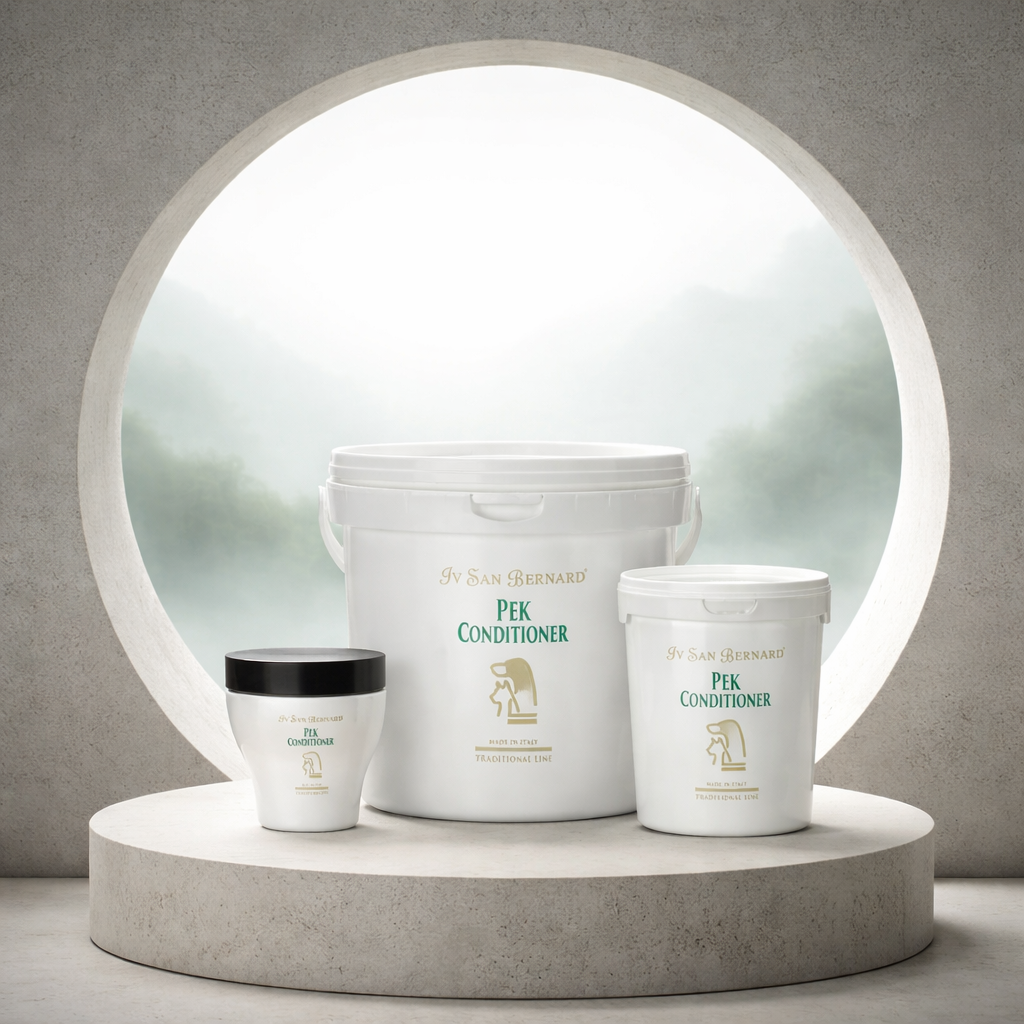
How Iv San Bernard Applies This Science
Professional Iv San Bernard routines recognise that coat preparation extends beyond cleansing. Conditioning systems are selected according to the desired cosmetic outcome.
For example:
-
Orange PEK & H270 Brushing spray, is frequently incorporated into routines where coat resilience, flexibility and brushability are priorities.
-
Passionfruit PEK is commonly selected for long or curly coats requiring enhanced manageability.
-
Black Cherry PEK supports cosmetic conditioning in many shorter coat types where maintaining natural body is important.
The objective is not to make every coat feel softer.
It is to prepare each coat for its intended finish while respecting its natural characteristics.
Frequently Asked Questions
Can conditioner increase hair elasticity?
Conditioners improve the cosmetic properties of the hair fibre and may enhance flexibility and manageability. They do not alter the hair's underlying biological structure.
Why does brittle hair break more easily?
Hair that has lost flexibility is generally less able to absorb mechanical stress, making fracture more likely when tension is applied.
Should every coat be made as soft as possible?
No. The desired cosmetic finish depends on the breed, coat type and grooming objective. Professional grooming aims to achieve the most appropriate finish for that individual animal.